
Are you still worried about your hands getting sore from using a nail polish scrubber or the long wait for nail polish removal? Have you ever dreamed of being able to remove nail polish, trim nails, and even create complex nail shapes with the speed and precision of a professional manicurist?
If the answer is “yes,” then you might need more than just a pair of deft hands. You’ll also need a handy nail art tool— a nail drill. Below, we’ll take you deeper into the versatile functions of a nail drill and provide you with a detailed buying guide to help you find the perfect tool to enhance your nail art experience.

Core functions of nail drill
At first, I thought a nail drill was only used to smooth nails, but after learning more about it, I found that by replacing the different grinding heads (Nail Drill Bits), it can handle almost all the steps of nail art.
Nail polish remover: This is one of the most common functions of a polisher. Using a dedicated ceramic or tungsten steel polishing head, you can quickly and efficiently remove nail polish, gel polish, extensions, and more, significantly reducing the time it takes to remove nail polish.
Nail shaping: With a dedicated polishing head, you can finely trim the edges and shape of the nails, making them more regular and symmetrical. This is especially important for creating complex nail shapes, such as square, round, or almond.
Removes dead skin and cuticles: The small grinding head gently removes dead skin and calluses from the edges of the nails, leaving them looking cleaner and neater. This feature greatly simplifies the preparation for a manicure.
Grinding and polishing the nail surface: Before applying nail polish or base coat, use a fine grinding head to lightly polish the nail surface to increase the roughness of the nail surface, enhance the adhesion of the nail polish, and prevent it from falling off. Use a polishing head to make the nail surface smooth and shiny.
Drilling and Engraving: For professionals who need to create intricate nail designs, a grinder is an essential tool. It can easily drill or engrave on artificial nail tips, allowing for more creative designs.
nail drill for you
When choosing my first nail drill , I considered many factors. Ultimately, I wanted a tool that was safe, effective, and a good value. Here are some of the key considerations I came up with:
Speed (RPM) and power
Beginners and home users: If you primarily use your nails for daily manicures and simple nail polish removal, choose a sander with a speed between 15,000 and 20,000 RPM . This range offers ease of use, safety, and affordability.
Professional nail technicians: If you work with a large workload and need to work with hard materials (such as acrylic nails), we recommend choosing a professional-grade sander with a speed of 25,000-35,000 RPM or higher. Higher speeds typically result in greater torque, which improves work efficiency and reduces the risk of jamming.
Handle material and design
Material: Metal handles , such as aluminum alloy or stainless steel, are preferred . They have good heat dissipation and can effectively prevent the handle from heating up due to long-term use.
Weight and vibration: A good nail drill handle should be moderately heavy, comfortable to hold, and have minimal vibration . Excessive vibration not only affects operating accuracy but can also cause hand fatigue.
Portability and power type
Corded sander: stable power, suitable for use on a fixed nail workbench.
Cordless (rechargeable) sanders: These offer excellent portability and flexibility for those traveling or making on-site calls. Consider the battery life when purchasing.
Noise and heat dissipation
Noise: Long-term noise can affect your mood. High-quality sanders usually use silent motors and make less noise.
Heat dissipation: A good heat dissipation system can ensure the machine works stably for a long time and extend its service life.
Accessories and Compatibility
Versatility: Make sure the sander handle you choose is compatible with the common 3/32-inch sanding heads on the market, so that you can more easily purchase and replace sanding heads with different functions in the future.
Included sanding heads: Many sanders come with a basic set, which is very useful for beginners.
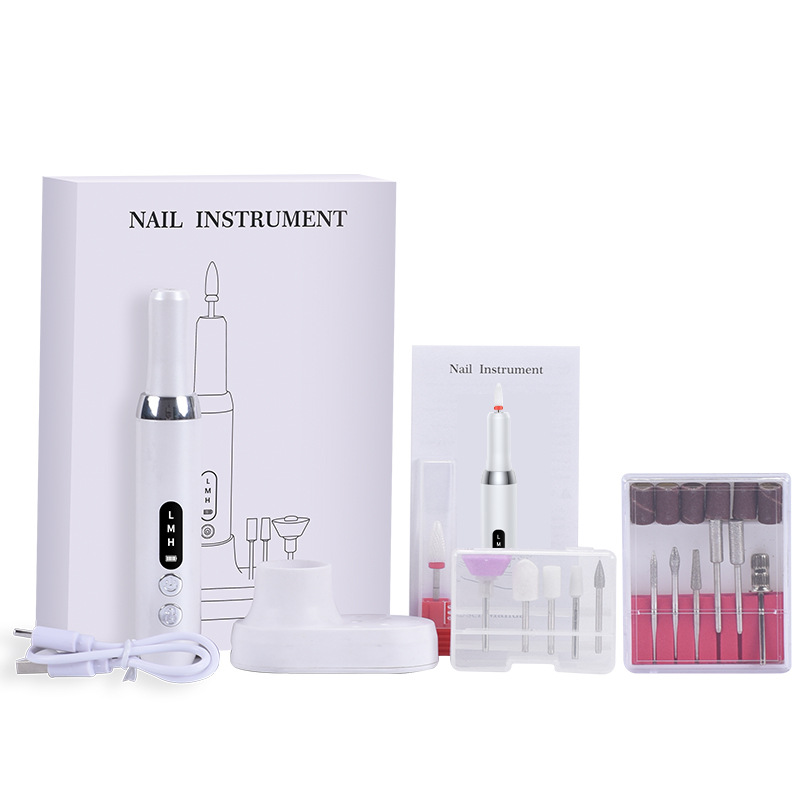
My recommendation: Nail instrument
After researching and trying out several nail polishers, I finally settled on Nail Instruments . I use their cordless nail drill , which is shaped like a pen and perfectly meets all my needs.
The following table is a summary of my use for your reference:
| category | Advantages |
| Material/Design | Made of high-quality ceramic grinding head , the material is hard and smooth, durable and not easy to wear. It is gentle on nails and skin and does not cause discomfort. |
| Functional | It integrates multiple functions such as nail removal, shaping, trimming, and polishing . You only need one tool to complete a variety of nail services without frequent replacement. |
| Portability | Lightweight and portable, it’s the size of a pen and can be easily stored. Its built-in high-performance rechargeable battery supports fast charging and long battery life , allowing you to enjoy your nail art anytime, anywhere. |
| performance | Equipped with a smart chip and intelligent speed regulation function , the maximum speed reaches 8000-20000 rpm. It has strong power and can quickly and efficiently remove thick nail polish. |
Summarize:
choosing a nail drill , consider your specific needs and budget. For beginners, an entry-level model with a moderate speed, comfortable feel, and low noise level is sufficient. Professional nail technicians, on the other hand, require more powerful performance, more stable torque, and greater durability.