
One of the most nerve-wracking situations during
Daily use of a nail drill is when sparks suddenly appear from the handle or inside the machine. Many beginners immediately think the machine has “exploded,” and some even mistakenly believe that nail powder has been “ignited.” So, what causes sparks during nail drill use? Does this mean there is danger? What should you do?
This article will provide a comprehensive analysis of the structural principles, safety hazards, identification of abnormal phenomena, situations that can be handled independently, and serious conditions that require immediate cessation of use, helping you accurately determine the source of the problem and avoid potential safety risks.
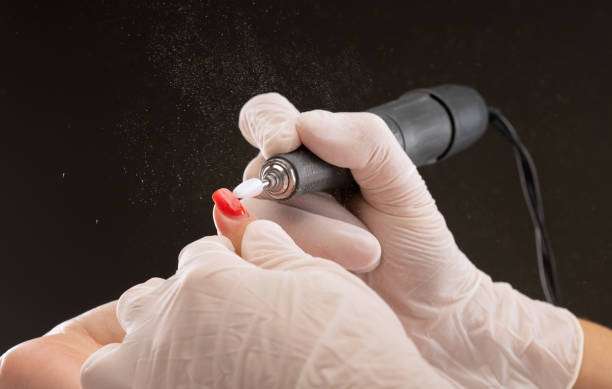
Nail drills produce sparks?
Under normal circumstances, a nail drill should not produce sparks.
Regardless of what you are using:
Entry-level home use
Portable wireless model
Mid-range professional model
High-end brushless motors
As long as the design is adequate and the internal structure functions properly, no sparks will be generated.
And once a spark appears, it usually means:
1. Severe wear of the carbon brush motor (most common cause)
Many affordable nail drills use brushed motors.
There is physical contact between the carbon brushes and the rotor, and wear can lead to the following:
Toner accumulation
Unstable contact
carbon brush edge breakage
Sudden change in speed
When the carbon brush cannot make stable contact, sparks or micro-sparks may occur.
Features:
The sparks came from inside the handle.
It is usually accompanied by a “sizzling” sound or fluctuating rotation speed.
The body temperature is higher than usual.
Sometimes accompanied by a slight burnt smell
This is the real reason why 80% of users encounter “spark.”
Other possible causes of sparks from a nail drill
Besides carbon brush wear, there are other factors that can cause sparks:
2. Poor contact in internal wiring.
include:
Loose solder joints
Damaged wire insulation
Poor plug contact
Electric sparks can also occur if there is a sudden contact between the circuits.
3. Powder entering the motor.
If you don’t clean the handle of your nail drill for a long time, the following things will accumulate:
nail powder
glue powder
dead skin dust
These dust particles are conductive and can be drawn into gaps when the machine is running at high speed, causing a brief short circuit and resulting in a slight spark.
This problem is more likely to occur in entry-level nail drills that use an open ventilation system.
4. Using a substandard charger or incompatible power supply
For wireless nail drills, if you:
Using a charger with an incompatible voltage
Use an inexpensive USB adapter
Using the device while charging
The current may be unstable, which can easily cause overload and lead to internal sparks.
higher risk for the wireless Nail Drill model)
An aging lithium battery or damaged circuitry can also cause sparks or micro-short circuits.
feature:
The sparks came from the body, not the controller.
Often accompanied by scalding
Bulging may occur
In such cases, use must be stopped, and operation should not continue.
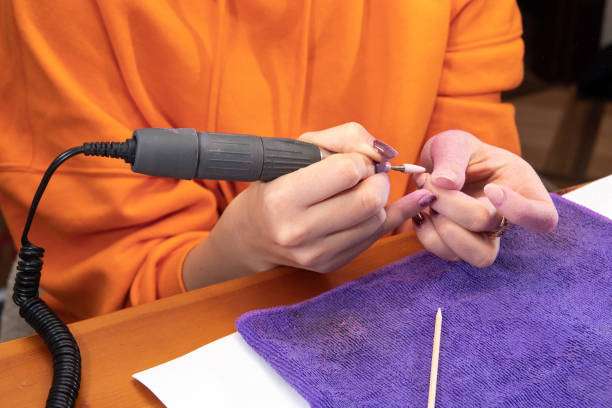
6. Damaged or stuck handle bearing
If sparks are accompanied by:
Noticeable vibration
Strange noise
The handle speed fluctuates.
It’s possible that internal bearing wear caused a sudden increase in motor load, triggering an electrical spark.
Determining the risk level of sparks emitted by a nail drill
This is a serious danger (stop operation immediately).
| Phenomenon | Hazard level | illustrate |
| There were obvious sparks inside the handle. | ★★★★★ | Motor malfunction or carbon brush damage |
| Accompanied by a burnt or smoky smell | ★★★★★ | High risk, could burn out the wiring |
| The device was so hot to the touch that sparks appeared simultaneously. | ★★★★★ | Short circuit or battery problem |
| Sparks kept appearing | ★★★★★ | Stop using immediately |
This is classified as moderately dangerous (do not use in the short term).
| Phenomenon | Hazard level | illustrate |
| Occasionally, slight sparks accompanied by unusual noises | ★★★★☆ | Mostly carbon brush wear |
| The spark came from near the charging port. | ★★★★☆ | Power supply voltage fluctuation |
This is a mild abnormality (it may recover after cleaning the dust).
| Phenomenon | Hazard level | illustrate |
| A large amount of dust entered the handle, causing a brief spark. | ★★★☆☆ | It may return to normal after cleaning. |
However, regardless of the severity, if sparks occur, it is not recommended to continue using it.
7 key signs of sparks appearing during nail drill operation
If your nail drill exhibits any two or more of the following phenomena, it is a major warning:
The speed fluctuates.
It gets hot within minutes of use.
A burnt smell appeared
The handle makes an unusual noise.
Sparks accompanied by strong vibrations
The sparks became more pronounced after the dust entered.
Flashing light when plugged in
The machine is no longer safe and stable as long as there is a spark.
Can it repair itself? In what situations is self-rescue ineffective?
You can try to handle it yourself (but recovery is not guaranteed).
Only in the following cases:
1. Brief sparks caused by dust accumulation (the mildest case)
Handling method:
Clean the handle vents with a small brush.
Use a blower to blow out the internal dust.
Suspended for 24 hours
If there is no burnt smell, it can usually be improved.
It must be taken out of service and repaired or replaced (in 80% of cases).
The following situations cannot be resolved by cleaning:
carbon brush wear
Motor burnout
bearing damage
Internal wiring arcing
Battery short circuit
In particular, the carbon brush motor is worn out and cannot be repaired; the only solution is to replace the handle or the entire machine.
Why are sparks more likely to appear during a nail drill?
1. The fundamental reason is that affordable machines use carbon brush motors.
Nail drills costing tens to hundreds of yuan use the lowest-cost carbon brush motors.
shortcoming:
Short service life
Operating by friction
Carbon brushes will wear out
Toner may cause sparks
Professional brushless nail drills, on the other hand, will not produce any sparks.
2. Prolonged use at high speeds accelerates wear.
If you are used to:
Start at maximum speed right away
Use continuously for 20–30 minutes without interruption
Increase load using cheap grinding heads
Carbon brushes wear out faster and are more likely to produce sparks.
3. Lack of cleaning habits leads to dust accumulation.
nail drills inhale nail powder over a long period of time, it will reduce the heat dissipation of the motor, increase friction, and thus increase the risk of sparks.
4. Inferior power supplies have poor stability.
In particular, the wireless version uses an uncertified USB fast charging adapter, which may cause voltage instability and lead to electrical sparks.
What to do if sparks occur during use? Six-step safety operation guide
Once you see sparks coming from the nail drill, immediately follow these steps:
1. Immediately stop using and turn off the device.
To avoid further damage to the internal structure.
2. Unplug the power source or disconnect the charger.
Avoid continuous short circuits.
3. Do not continue to try to power on.
The sparks indicate an internal problem.
4. Check for any accompanying burning smell or smoke.
If present, the highest level of danger.
5. Let it cool down slightly to allow the equipment to cool completely.
To avoid exacerbating heat damage.
6. Assess whether professional repair or replacement of the machine is required.
Most cases of sparking require replacing the handle or the entire nail drill.
How to avoid sparks during nail drilling?
1. Do not use the highest speed for extended periods.
Excessive motor load will accelerate wear.
2. Clean the handle and ventilation holes regularly.
Clean your nails at least every 3–5 manicures.
3. Use high-quality grinding heads
Low-quality sandpaper rings are more likely to cause unstable loads.
4. Do not use the wireless version while it is charging.
This will cause voltage fluctuations.
5. Prevent dust from entering the motor.
Tilt the handle slightly during use to reduce dust inhalation.
6. Select the brushless nail drill model.
Brushless motors are more stable and almost never produce sparks.
7. Check promptly if you feel increased vibration.
Increased vibration is usually a warning signal for bearings or motors.
In conclusion:
A nail drill is never normal. Possible causes include worn carbon brushes, motor damage, internal short circuits, etc.
For safety and stability, once sparks occur, it is not recommended to continue. Click to view and purchase our high-quality nail drill to ensure a safe and successful manicure.