
Sculpted nail art has always been one of the most creative and challenging aspects of nail art. Traditional hand-sculpting requires extremely high precision and patience, but with the popularization and technological advancements of nail drill they have become more than just tools for filing or removing nails; they have become an important assistant for innovative and efficient sculpted nail art. In the years I’ve been a nail art enthusiast, I’ve found that nail drills have completely transformed my sculpting experience, making complex designs controllable and efficient while retaining the joy of creation.

Precision Engraving: Grinding Head Selection and Speed Control
In sculpted nail art, precision in detail is paramount. The shape and material of different grinding heads directly determine the sculpted effect.
Diamond grinding head: Suitable for carving fine lines, with a smooth surface that reduces friction on the nail surface.
Conical ceramic grinding head: suitable for carving curves and grooves, achieving smooth lines.
Small tungsten carbide grinding head: suitable for carving hardened or thick carapaces, ensuring cutting efficiency.
Speed control is also crucial for nail art. When carving petals, I personally set the nail drill to a low speed (around 8,000–12,000 RPM) to ensure smooth lines and clear layers. When working with harder gel nails or acrylic nails, I increase the speed to 18,000–20,000 RPM to reduce resistance and discomfort caused by friction between the drill head and the nail surface.
Scientifically speaking, high speed reduces torque. If the torque of the nail drill is insufficient, vibration or uneven tool marks may occur during engraving. Therefore, choosing a high-torque, brushless motor nail drill is an important prerequisite for ensuring engraving accuracy.
Multi-angle operation: Handle and foot pedal combination
Sculpted nail art requires precise manipulation of the nails at various angles. The lightweight handle design and high-precision bearings of the nail drill allow for more stable hand operation, reducing errors caused by vibration.
Some high-end models are equipped with foot pedal control, which allows you to adjust the speed by foot, letting your hands focus on the carving details. I remember the first time I tried foot pedal operation; my hands and eyes could be completely focused on the tiny patterns without having to frequently adjust the speed. This made me complete the complex rose carving half as fast as before, and the lines were smoother.
This operating method is especially important when carving petals, leaf veins, or geometric patterns, as it maintains hand stability and allows for quick adjustments to the rotation speed, preventing shaking during operation.
Creative carving techniques
Nail drills not only make carving more efficient but also enable creative effects that are difficult to achieve with traditional handcrafts:
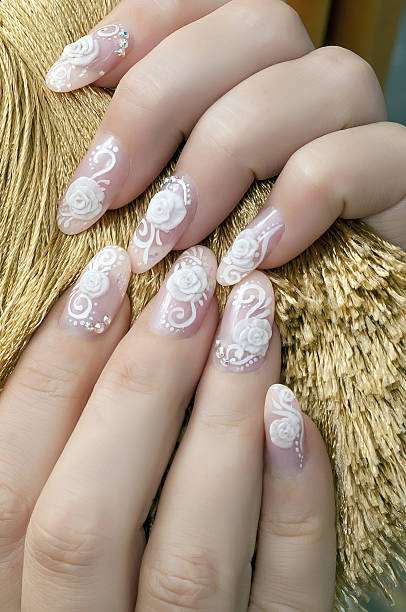
Three-dimensional flower shape: Use a small conical grinding head to lightly remove the nail surface material to create the layered effect of the petals.
Groove texture: Using a fine grinding head to carve along the design lines to achieve a three-dimensional groove texture, making the fingertip design more layered.
Gradient polishing: By adjusting the speed and pressure, a seamless transition between carving and polishing is achieved, allowing the pattern to transition naturally.
Mixed material sculpting: Alternate between ceramic and tungsten steel grinding heads on gel nails or acrylic sculpting to achieve different textures and effects.
I personally experimented with carving petals and leaves on the same nail, using different grinding heads and speed combinations to create an effect similar to miniature three-dimensional floral art. This creative application was almost impossible beforehand; hand carving would have required several times the time and effort, but nail drills make it efficient and controllable.
Safety and Material Protection
In nail sculpting, protecting both the nails and the equipment is equally important. The following points should be noted when using a nail drill correctly:
Pressure control: Applying too much pressure may damage the nail surface, while too little pressure will result in unclear carving.
Grinding head selection: Use tungsten carbide grinding heads for hardened nails and ceramic or diamond grinding heads for regular gel nails.
Heat dissipation management: Prolonged high-speed carving will cause the handle and nail surface to heat up, so the machine should be stopped periodically to cool down.
Equipment cleaning: Keep the grinding head and handle clean to avoid dust and debris affecting the carving accuracy.
Scientific research shows that properly controlling the rotation speed, pressure, and grinding head selection can not only extend the life of the nail drill but also ensure the carving effect and nail health.
Future New Directions
Holiday-themed sculpting: Complex patterns such as snowflakes, leaves, and Christmas designs can be created using a combination of multiple grinding heads, enhancing the creative experience of holiday nail art.
3D floral art: Utilizing three-dimensional carving techniques, fingertip designs present a miniature three-dimensional art effect.
Hybrid nail art: Combining crystals, nail stickers, and sculpting, nail drills provide precise cutting and polishing support for more refined designs.
Intelligent Assisted Carving: With the intelligent upgrade of the nail drill, automatic speed adjustment, pressure sensing, and intelligent carving assistance functions may be added in the future, making creative carving more efficient and precise.
In a nail art design competition, I tried using different combinations of grinding heads to create holiday-themed sculpting designs. The snowflake pattern sculpted with the nail drill was not only quick to complete but also had a very clear three-dimensional effect for each petal. This gave me a new understanding of the potential of the nail drill in sculpting nail art.
Summarize
Nail drills in sculpting nail art have far surpassed their traditional function of nail filing. Scientifically selecting the drill head, properly controlling the speed and pressure, and combining handle and foot pedal operation not only improves the precision of the sculpting but also allows for the efficient execution of creative designs. Whether you’re a DIY nail art enthusiast at home or a professional nail technician, understanding these scientific principles will make sculpting nail art safer, more comfortable, and more creative.
Nail sculpting is no longer just a simple craft art but a fusion of technology and creativity. Have you ever tried using nail drills for intricate sculpting designs? Feel free to share your experiences and tips in the comments!